

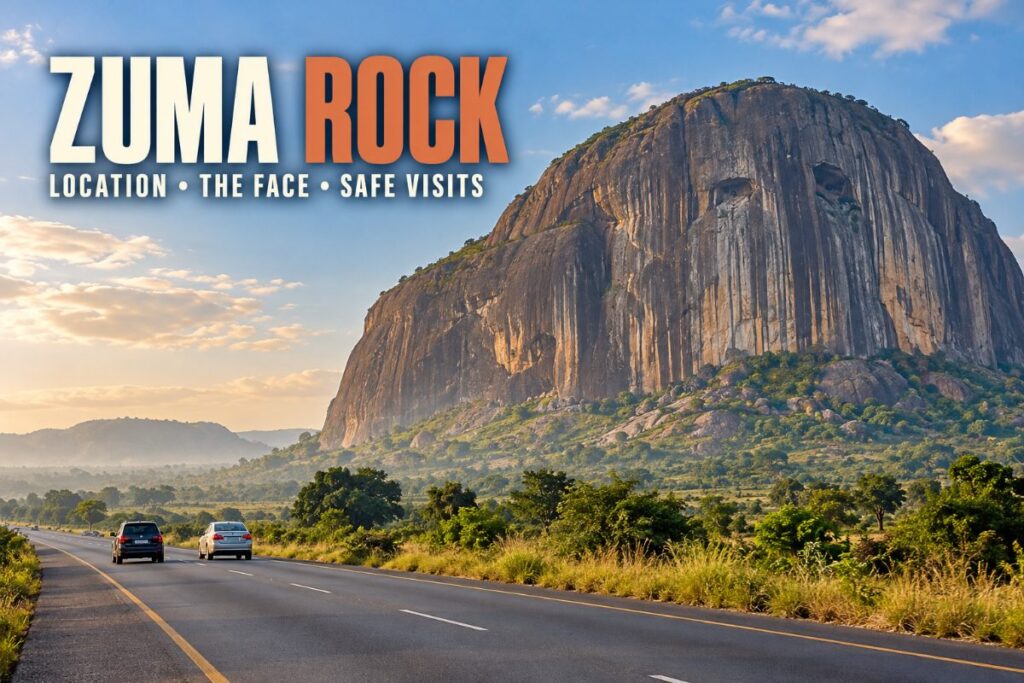
Zuma Rock rises from the plain beside the Abuja-Kaduna road at Madalla, close enough to the capital that many people assume it belongs to Abuja. It does not. The rock is in Niger State, and that matters because the security advice for Niger State differs from the advice for the FCT.
Below you will find exactly where it stands, why its height is quoted so differently, what the face is and what locals believe about it, how to get closer through the resort, and the rules on climbing, photography and drones.
Zuma Rock Location and Getting There
The rock stands at Madalla in Suleja Local Government Area of Niger State, on the Abuja-Kaduna road. The Federal Ministry of Information’s tourism page describes it as about half an hour’s drive from the centre of Abuja, while other reports give roughly 40 to 50 km. Traffic through Zuba can stretch that considerably.
ICIR describes the village at the foot of the rock, where a military checkpoint stands, as lying on the Niger State and FCT border near Madalla. So the state line is close, but you cross it before you reach the rock.
Hire a car and driver for the round trip instead of counting on finding a ride back from Madalla. Agree the waiting time and the price before you leave, and plan to be back in Abuja well before dusk. If you are tracking the cost, the road view is free, and the only published charges are the resort’s, covered below.
The rock fits into a day of sightseeing with the places in our list of beautiful and fun places to visit in Abuja, as long as you do the Madalla leg first and in daylight. Morning light is kinder for photographs, and rain makes any rock surface slippery and the road slower.
Is It Safe to Visit?
Read this before the sightseeing detail. The UK Foreign Office advises against all but essential travel to Niger State, and the US State Department lists Niger State among its “Do Not Travel” areas, citing terrorism, crime and kidnapping. Neither advisory is about the rock specifically, but both cover the land around it.
There is also a fixed local precedent. On 28 July 2022, gunmen attacked the military checkpoint in the village at the foot of the rock, and troops from the Zuma Barracks Army Base repelled them, according to ICIR. Residents told the outlet that security presence in the area was thin.
None of this means every visit goes wrong, and plenty of vehicles pass the rock daily. It does mean you should keep the visit short and controlled:
- Go by day, in a vehicle, and leave Madalla by mid-afternoon.
- Do not stop on the expressway shoulder, at the checkpoint or beside soldiers.
- Do not photograph the checkpoint, troops or vehicles.
- Carry a valid ID, slow down at checkpoints and follow instructions from officers.
- Check recent news and ask the resort about the road before you set out.
- Tell someone in Abuja where you are going and when you expect to be back.
Check your travel insurance and your employer’s rules too, since both often follow these advisories.
Height and Geology
How high is Zuma Rock? Zuma Rock height is quoted in two incompatible ways, and both are repeated as fact. Wikipedia gives a summit of about 725 m above sea level and a prominence of about 300 m, meaning the rock stands roughly 300 m above the land around it. TheCable and many travel pages instead say it rises 725 m above its surroundings, which probably mixes up the two measurements.
The safest reading is that the summit is about 725 m above sea level and that the rock stands roughly 300 m above the plain. If a source gives only one number, check which of the two it means.
Descriptions of the stone differ as well. Wikipedia calls it an intrusion of gabbro and granodiorite. A report on a geoparks workshop held at the rock in August 2026 describes younger granitic to syenitic intrusions in older basement rock, formed about 600 million years ago. All agree it is an inselberg, a single mass left standing as the softer ground around it wore away.
The Face and Local Beliefs
The Zuma Rock face is the pattern of hollows on the upper rock that visitors read as eyes and other features. The Federal Ministry of Information records that early residents believed two depressions on the upper rock were eyes that could detect danger and warn them through oracles.
Writing in TheCable, Bolaji Alonge says he long believed the face came from human intervention or rock blasting, but that his research showed it comes from natural weathering and erosion.
The beliefs around the rock are older than any tourism plan. Wikipedia records that the Emir of Abuja once sent annual animal sacrifices to the guardians of the rock’s deity, and that some locals believe evil spirits live inside it. These are living beliefs for the communities nearby, so ask before photographing people, homes or shrines.
History and Tourism Plans
Zuma Rock history starts with the Zuba people, who are said to have found it in the 15th century and called it zumwa, which may translate as “a place of guinea fowls”. The Gbagyi, also called Gwari, later used it as a defensive retreat during wars with neighbouring groups.
Plans to turn it into a tourist centre have a long and unfinished record. Wikipedia mentions an unfinished hotel project nearby, and the Federal Ministry of Information presents the rock mainly as a picnic and relaxation spot rather than a developed attraction.
The main official plan for the site is a geopark. On 17 and 18 August 2026, the First Nigeria Workshop on Geoparks met at the resort and launched the Greater Zuma Geopark Initiative, led by a committee under the Niger State Government. It is described as an emerging national geopark with UNESCO Global Geopark status as a long-term goal, and the workshop was not a UNESCO event.
The initiative covers a wider landscape than the rock alone, including nearby inselbergs, ridges and drainage systems, and the area towards Gurara Waterfalls. The next steps are mapping geosites and community engagement, so a ticketed park with set hours is not part of the published plan.
Zuma Rock Resort and Getting Closer
The Zuma Rock resort is the best-documented way to get close to the rock. Despite what searches for Zuma Rock Resort Abuja suggest, it is in Niger State, and its address is A2 Daura Road, KM6 Abuja-Kaduna Expressway, Zuma Rock, Niger State. The published contacts are +234 812 337 5147 and booking@zumarockresort.com.
The website lists Classic rooms at ₦130,000 per day and Deluxe rooms at ₦135,000, both bed and breakfast. It also lists a private golf course, cycling routes, outdoor walkways, a rocky stream, a children’s playground and a gym. Rates change, so confirm them before you book.
What it does not publish is a day-visitor fee, opening times or rules for non-guests. Call or message first instead of driving out and hoping. The workshop’s field trip visited a cultural and archaeological rock cave reached by 342 newly built steps at the resort, but nothing says whether ordinary visitors can use them.
If you would rather stay in the city and make this a day trip, our hotels in Abuja with prices guide compares options by district.
Climbing, Photography and Drones
No Niger State source describes a marked climbing route, a permit system or rescue arrangements for the rock. Bare rock is slippery when wet and has no handrails, so do not climb without arrangements you can name: who authorises it, who guides you and what equipment they supply.
For photographs, TheCable’s writer shot from the golf course behind the rock, from the side facing Madalla town and from the Suleja-Kaduna road. A long lens from a safe, lawful spot beats stopping on the expressway.
Drones need more care. In 2016 the Nigerian Civil Aviation Authority banned launching drones without its own permit and one from the Office of the National Security Adviser. With an army base and a checkpoint beside the rock, flying without both permits invites trouble.
Frequently Asked Questions
Zuma Rock Is Found in Which State of Nigeria?
Niger State, at Madalla in Suleja Local Government Area, right beside the FCT boundary. It is not in Abuja, although many people assume it is.
Is Zuma Rock in Abuja or Niger State?
It is in Niger State, at Madalla in Suleja Local Government Area. The FCT boundary is right beside it, which is why the two are so often confused.
Is There an Entry Fee?
Looking at Zuma Rock from the road costs nothing, and no official ticket price is published. The resort charges for rooms and golf, and it does not publish a day-visit rate, so ask first.
Can Visitors Climb the Rock?
No official route or permit system is published. Do not attempt it unguided, and ask the resort or community leaders what, if anything, is permitted before you pay anyone.
Is the Face on the Rock Carved?
No. Writing in TheCable, Bolaji Alonge says his research points to natural weathering and erosion, not carving or blasting.
Why Do People Search for Zuma Rock Crying?
The phrase shows up in search suggestions, but neither Wikipedia nor TheCable describes anything of the kind, and TheCable explains the face as natural weathering and erosion over millions of years. Treat any claim of a crying rock as unverified unless an official source confirms it.
Plan a Short Daylight Trip
The best visit is early, short and planned around the resort or a fixed viewing point rather than the roadside. The geopark initiative’s study area reaches towards Gurara Waterfalls, so a second stop in Niger State is tempting. Check its security position separately, and see our Gurara Waterfalls guide for what the falls involve.




Leave a Reply