

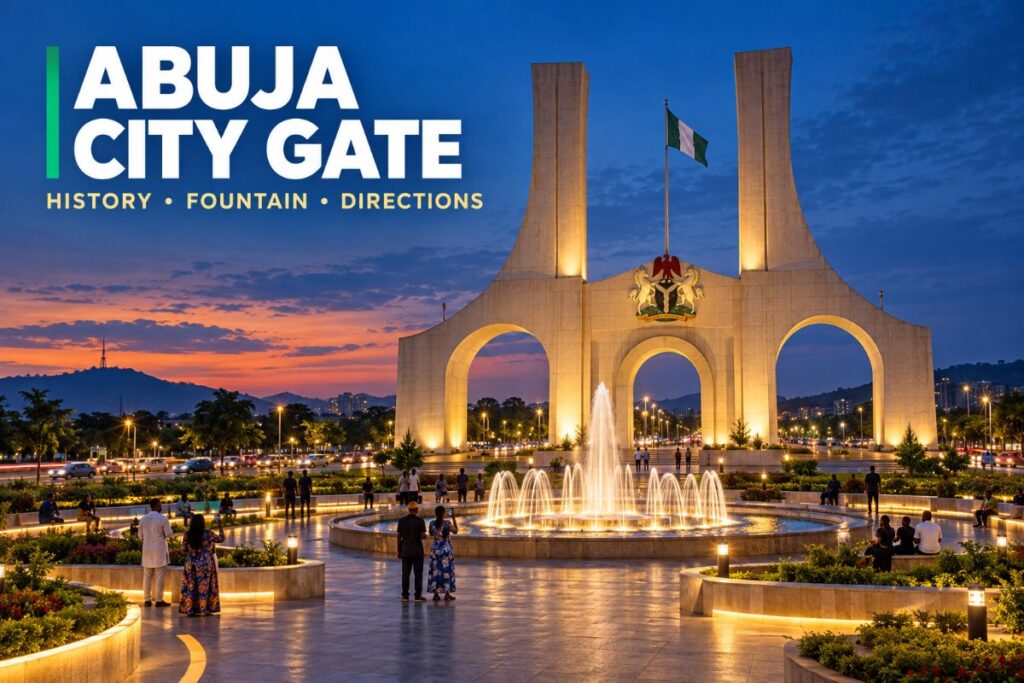
For years the arches on the road in from the airport were a landmark people drove past, not somewhere they stopped. After a full remodel, Abuja City Gate has turned into an evening hangout with a fountain, lights and a car park, and visitors ask practical questions: is entry free, when does it fill up, and how do you reach it from the airport?
Below you will find the history of the monument, what the remodel actually added, the exact spot and the roads that lead to it, what visitors and vendors charge, and how to plan a photo session or a late visit without problems.
Abuja City Gate History
The monument’s history starts in 1991, when the monument was erected under the Babangida administration to mark the move of the federal capital from Lagos to Abuja. The FCT Administration’s own monuments page is less precise and says only that it was built in the early 1990s as a ceremonial entrance to the new capital.
The structure is concrete, about 25 metres high, with arches topped by a flag and the coat of arms and the words “You Are Welcome”. Wikipedia describes three arches: two large inverted columns framing the flag, and a smaller central arch carrying the coat of arms.
That makes the monument as old as the capital’s status: 1991 is the year Abuja took over from Lagos. Over the years the site deteriorated through neglect, according to Voice of Nigeria. ThisDay also reported that before the remodel the spot had a reputation for robbers and drug users.
The Abuja City Gate Renovation
The remodel began with a challenge from the First Lady. FCT Minister Nyesom Wike said Senator Oluremi Tinubu asked officials to make the gate befit a national capital. The contract went to Julius Berger, working with the Federal Capital Development Authority (FCDA), in November 2025.
The Abuja City Gate inauguration took place on 9 July 2026, when the remodelled gate was commissioned with the First Lady representing President Tinubu. The event was tied to the third anniversary of the administration and the FCT’s 50th anniversary. What was added, according to the commissioning reports:
- A Unity Fountain with 37 nozzles, representing the 36 states and the FCT.
- An irrigation system and new lighting.
- A car park with 60 spaces.
- Public conveniences and enhanced security facilities.
- Food courts and recreational areas, as described by Wike.
- Landscaping, fencing and a wall painting of some of Nigeria’s independence leaders, according to ThisDay.
At the commissioning, President Tinubu’s message, delivered through the First Lady, was that the gate tells arriving visitors they have entered “a city built on unity, diversity and shared aspirations”. None of the commissioning reports gave a final cost. Wike also said the FCT Administration would sign a maintenance agreement with Julius Berger so the monument does not fall back into neglect. ThisDay notes that some critics called the project a misplaced priority.
Abuja City Gate Before and After
Set the Abuja City Gate before and after the remodel side by side and the change is stark. Before it, Voice of Nigeria described a monument that had deteriorated through neglect, and ThisDay said the spot had a reputation for robbers and drug users. After it, the site has a lit fountain, a fenced plaza, a 60-space car park, public conveniences and extra security facilities. The arches themselves are the same 1991 structure, now with a cleaned-up setting.
Abuja City Gate Location and Directions
The Abuja City Gate location is in the Kukwaba district, on the road from the airport into the city. That road is the Umaru Musa Yar’Adua Expressway, formerly known as Airport Road, which runs 37.5 km between the airport and the city centre.
ThisDay places the gate near the National Stadium complex, where Umaru Yar’Adua Road meets Constitution Avenue and Independence Avenue coming from the Three Arms Zone. On a map, the coordinates listed by Wikipedia are about 9.0354 N, 7.4483 E, and searching the monument by name in a ride-hailing app also works.
From the Airport
You pass the gate on the expressway heading into town, so it is an easy first stop if you have time before checking in. Ask your driver to use the gate’s car park instead of stopping on the carriageway, which is dangerous at any hour. If you are still choosing how to get into Abuja, our Lagos to Abuja flight price guide compares airlines and fares.
From the City Centre
A ride-hailing trip to the gate’s pin is the simplest option, and the same pin works for the return. If you would rather go by train, our Abuja Metro Rail guide covers the airport line, but no published source confirms a walking route from a station to the gate, so check the distance on a map before you rely on it.
Parking
Voice of Nigeria reports a 60-space car park. On weekend evenings that is likely to fill, so arrive early or use a ride-hailing drop-off.
Visiting Times, Costs and Crowds
No official opening or closing times have been published. A Daily Trust report found the site quiet in the morning and busy from about 4pm, often until midnight, with Friday to Sunday the peak.
Entry is free, according to ThisDay and to a Berger Construction foreman who told Daily Trust it was free “for now”. Rules and charges can change, so confirm at the gate.
Visitors come for dates, birthdays, weddings and other celebrations, and ThisDay notes that school excursion groups visit too. What you may spend money on:
- Photographs: Daily Trust found photographers charging ₦1,000 for a soft copy.
- Food and drinks: Sellers offered Nigerian meals, shawarma, fries, smoothies, drinks and popcorn.
- Transport: One visitor told Daily Trust that her fare was her only cost.
Some vendors said they paid no space fees while the facility was still being developed, and Daily Trust noted that some offices and services were not yet fully operational. Expect the line-up of stalls and prices to change.
What the Reports Do Not Settle
Several practical points are not published, so confirm them on arrival instead of assuming:
- Official opening and closing times.
- Any charge for the car park.
- Rules for tripods, lighting and professional shoots.
- How traffic passes the arches, and whether visitors can walk beneath them.
- The walking route from a rail station to the plaza.
The Abuja City Gate Fountain and Photography
The Abuja City Gate fountain is the main attraction. Daily Trust describes a fountain floor shaped like a map of Nigeria, with the states marked on its surface, and says it is lit after sunset and is the most popular photo backdrop.
For the cleanest Abuja City Gate photos, shoot the arches from the plaza side rather than from the road. Stay out of the traffic lanes for the angle, and do not climb on the fountain or the walls.
An Abuja City Gate video shot on a phone, such as a slow pan across the lit fountain after sunset, needs no special setup. No published rules cover tripods, lighting or professional shoots, so ask the security staff before you set up anything bigger. Drones need permits from the Nigerian Civil Aviation Authority and the Office of the National Security Adviser, so leave one at home unless you have both.
Abuja City Gate at Night
Abuja City Gate at night is when most people come. The lighting is part of the remodel, ThisDay describes neon lights in the garden, and the lit fountain draws the evening crowd. The gate is fenced, and ThisDay says the large car park makes it feel safe to stay late.
That reassurance has limits. A busy weekend crowd can attract pickpockets, as in any city, so keep your phone out of back pockets, leave valuables in the car or at home, and arrange your return ride before the battery runs low.
Wike has spoken of staging a New Year fireworks display at the City Gate. The report gave no date or access arrangement, but if one is held, expect heavy traffic and crowds that night, and check with the FCT Administration before you plan around it.
A Simple Plan for a First Visit
- Choose your mood. Mornings are quiet, but the fountain lights only show after sunset, and Friday to Sunday evenings bring the crowd.
- Use the gate’s pin and aim to arrive before 4pm if you are driving, because the car park is small.
- Walk the plaza first: the arches, the wall painting of independence leaders and the fountain floor shaped like Nigeria.
- If you chose an evening, stay through sunset to see the lighting, and take your photographs while the sky still has colour.
- Eat from the vendors or move on to dinner elsewhere, and book your ride before you leave the plaza.
Allow roughly an hour. Longer visits make sense only if you are meeting friends or celebrating something.
Frequently Asked Questions
Is There an Entry Fee at the City Gate?
None has been reported. ThisDay and Daily Trust both describe free entry, though you pay for photographers, food and transport.
When Was the Abuja City Gate Built?
The common date is 1991, as in Voice of Nigeria and Wikipedia. The FCT Administration’s page says only “early 1990s”. The remodel was commissioned on 9 July 2026.
Can I Visit in the Morning?
Yes, and it is quiet, according to Daily Trust. The fountain lighting only shows after sunset, so you choose between calm and atmosphere.
Who Maintains the Gate?
Wike said the FCT Administration would hand maintenance to Julius Berger under a formal agreement. The reports do not give the agreement’s length or terms.
Pair the Gate With an Evening Out
The gate works best as a short sunset stop on the way into or out of town. For a longer evening with a meal and a film afterwards, our Jabi Lake Mall guide covers hours, parking and cinema prices, so you can line up the second half of the evening.




Leave a Reply