

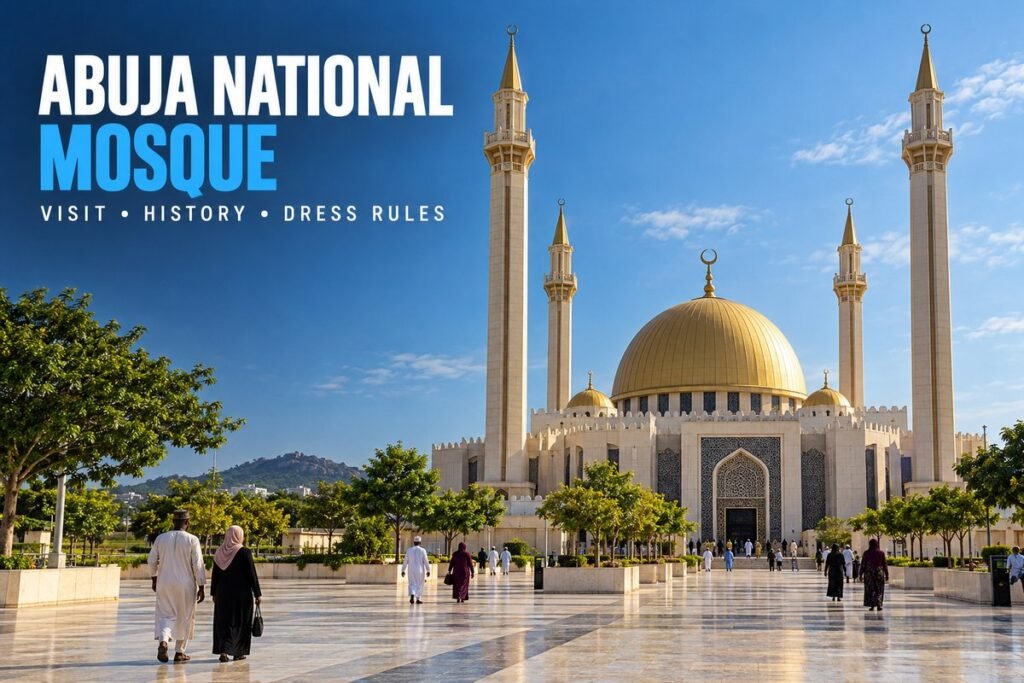
The Abuja National Mosque has its golden dome and four minarets in the middle of the capital, and it opens its gates to visitors of every faith whenever worship is not in progress. It faces the National Christian Centre across Independence Avenue, which is why many people see both on the same trip.
This guide covers how to find it, how it came to be, who leads it, what you can see and the rules that make a visit smooth. It is written for first-time visitors, including tourists and non-Muslims who want to know what to expect before they arrive.
Finding the Mosque
The abuja national mosque location is Independence Avenue in the Central Area, the part of the capital where the main government and cultural buildings stand. Ride-hailing drivers and taxi drivers know it as the National Mosque, and if there is any confusion, name the National Christian Centre, because the two face each other and are the best-known landmarks on the road.
| Item | What to expect |
|---|---|
| Street | Independence Avenue, Central Area |
| Opposite | The National Christian Centre |
| Landmarks | Golden dome, four minarets |
| Visiting | Open to the public except during congregational prayers |
| Best time | A weekday morning |
Ask the driver to drop you at the main gate, and arrange your return pickup before you go in, because a long visit can leave you waiting for a ride at a busy hour. Allow extra time on Fridays, when congregational prayers draw large crowds and traffic around Independence Avenue slows. Our guide to the best restaurants in Abuja helps you plan a meal close by afterwards.
How the Mosque Came to Be
The mosque was proposed in 1981 as a national place of worship for the new capital, and it was built in 1984, though some records give 1985 for completion. The general contractor was Lodigiani Nigeria Limited, and AIM Consultants provided the design.
It rose while the capital itself was still taking shape, and it has since become one of the buildings most closely tied to the city’s image. The golden dome is the feature that most photographs are built around. Its position opposite the National Christian Centre is often pointed to as a symbol of religious coexistence, since the main national buildings of the two faiths stand within sight of each other, and that is the story most guides tell first.
Who Leads the Mosque
Visitors who ask about the abuja national mosque imam are usually asking who leads the prayers and who runs the place. Religious affairs sit with the Nigerian Supreme Council for Islamic Affairs, which appoints the resident and visiting imams and has since added five more to the team. Dr Abdulkadir Salman Solagberu, a scholar from Kwara State, is among those named. Some reports describe him as the chief imam, while others list him as an imam representing the North Central.
Anyone searching for the abuja national mosque chief imam should treat titles as something that can change. If you plan to meet the leadership, request a talk or attend a special service, call or write to the mosque’s administration beforehand and confirm who will be available, because a title that was right when a report was printed may not be right on the day.
Inside the Complex
Visitors who want to know what the abuja national mosque inside looks like will find a large prayer hall beneath the main dome. The complex also has a conference centre that can serve about 600 people, along with other facilities for study and for the mosque’s staff. Four minarets rise around the building, and the courtyard is a good place to take in its scale before you go further in. Stand back far enough to see the dome and the minarets together, because the proportions that make the building recognisable only show from a distance. Then walk closer and notice how the scale changes: the courtyard, the entrance and the dome each give a different sense of the size.
Come with a short list of questions. Ask a member of staff about the history of the building, which parts are open to visitors that day and where visitors are asked to stand. Staff are used to curious guests, and a polite question usually gets a helpful answer.
Abuja National Mosque Capacity
Estimates of the capacity of the main hall vary widely, and no single number is dependable. A figure often quoted for the Friday congregation is about 15,000 worshippers, while the conference centre seats around 600. If you need an exact figure for an event, ask the management directly. Plan to spend about an hour if you want to walk the grounds, see the main hall and ask questions.
Prayer Times and Friday Gatherings
Muslims pray five times a day, and the main weekly congregation gathers at midday on Fridays. During congregational prayers the mosque is closed to casual visitors, and the grounds fill up quickly. Ask the gatekeepers for the arrangements on the day you arrive, and avoid prayer times. During Ramadan and on major festival days, expect large crowds and different arrangements from the rest of the year.
Rules for Non-Muslims and Tourists
The mosque is open to the public, including non-Muslims and tourists, except while congregational prayers are being held. Because prayer times shift through the year, avoid Friday midday and check the arrangements at the gate.
What to Wear
Dress modestly. Men should wear long trousers and a shirt that covers the shoulders. Women should wear a long skirt or loose trousers, cover their arms and bring a scarf for their hair. Remove your shoes before you enter the prayer areas, and wear socks if you prefer. Keep clothing loose and plain, and avoid transparent fabrics.
Behaviour Inside
Speak quietly, switch your phone to silent and do not walk in front of anyone who is praying. Ask before you enter any part of the building you are unsure about. If a guide offers to show you around, agree on any tip beforehand. Children are welcome as long as they stay close and keep their voices down, and a school or tour group should contact the management in advance so that the visit can be planned around prayer times and crowds.
Visiting With a Group or Family
A group is welcome when the visit is arranged in advance, and the staff can suggest a quiet time of day. Brief everyone beforehand on the dress rules, because it is easier to sort out scarves and long sleeves in the car than at the gate. Keep a small group together, appoint one person to speak for it and tell younger children that the mosque is a place of worship before you go in. Visitors who arrive with a clear plan usually spend less time waiting and see more.
Abuja National Mosque Photos
Many visitors want abuja national mosque photos, especially of the dome. Photography of the exterior is usually fine from the courtyard, but ask permission before you take photos inside, and never photograph worshippers without their consent. If you plan to fly a drone, ask the management first. The best light for exterior shots is in the morning, when the dome catches the sun against a clear sky, and the harmattan haze in the dry season gives the building a soft look in photographs.
Your Visit Step by Step
A calm visit follows a simple order. Following it keeps you out of the way of worshippers and gives you the best views.
- Arrive on a weekday morning, before the midday prayer, and tell the gate staff that you are a visitor.
- Take off your shoes at the entrance and carry them in a small bag so that you do not need to come back for them.
- Walk the courtyard first, then ask which parts of the interior are open to visitors that day.
- Take your exterior photographs last, once you have a sense of where people are praying.
- Leave quietly before the midday prayer begins, and thank the staff who helped you.
Abuja national mosque reviews vary with the day and the crowd, but it is one of the capital’s essential stops. It lacks the commercial feel of many attractions, the architecture rewards a close look, and the sight of two great places of worship facing each other says a lot about the city. Our list of beautiful and fun places to visit in Abuja suggests what else to add to your day, and the green spaces at Millennium Park make a relaxed stop afterwards.
Frequently Asked Questions About the Abuja National Mosque
Where is the mosque located?
It is on Independence Avenue in the Central Area of Abuja, across from the National Christian Centre.
Can non-Muslims visit the National Mosque?
Yes. It is open to the public, including non-Muslims, except during congregational prayers.
What should I wear?
Dress modestly with arms and legs covered. Women should cover their hair, and everyone removes shoes before entering prayer areas.
Can I take photos at the mosque?
Exterior photos from the courtyard are usually fine. Ask permission before photographing inside, and never photograph worshippers without consent.
Planning Your Visit
Go on a weekday morning, dress with care, leave your shoes at the entrance and move quietly. The Abuja National Mosque offers a calm break from the city, and it gives visitors a clearer picture of the capital’s religious and architectural character than most other stops.




Leave a Reply