

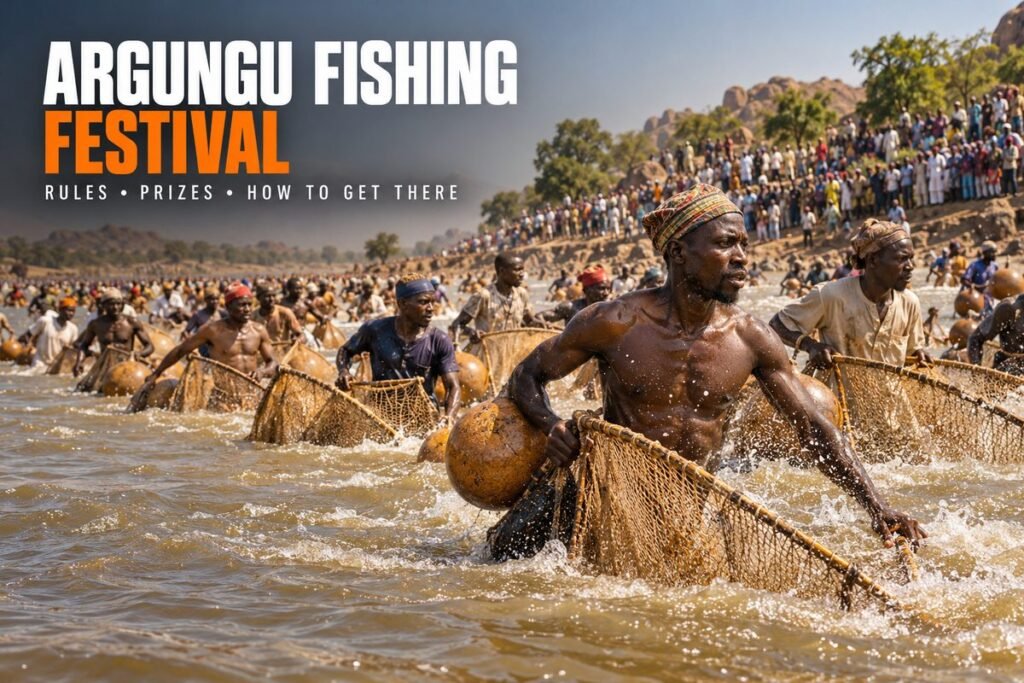
The Argungu Fishing Festival is one of the most unusual events on Nigeria’s calendar, a river contest in Kebbi State with a long history and rules that protect the water it is fought on. Anyone planning to see it has questions about when to go, what happens on the day and whether the journey is sensible.
This guide explains how the festival began, how the contest works, who wins what, what else is on the programme and how to get to Argungu from Birnin Kebbi or Sokoto. It also covers the security question that every visitor to the north-west should weigh before booking.
Argungu Fishing Festival at a Glance
| Item | Detail |
|---|---|
| State | Kebbi State |
| Town and river | Argungu, on the Matan Fada River |
| Usual time | February, over several days |
| People | The Kebbawa, also written Kabawa, a Hausa subgroup |
| Contest | One fishing contest of about an hour |
| Local name | Fashin Ruwa, meaning fishing of the water |
| Nearest large town | Birnin Kebbi, about 53 km away |
People who ask for the argungu fishing festival date should know that it is not fixed to one day. The programme runs for several days, usually in February, and the latest edition ran in mid-February with the main contest on the Saturday. The Kebbi State Government announces the dates each year, so check an official announcement before you book a flight or a room.
The festival belongs to the Kebbawa, the people of the old Kebbi Kingdom, who are a Hausa subgroup, though Fulani and other communities also live in Argungu.
Argungu Fishing Festival History
The modern festival dates from 1934. A peace accord that year between Sultan Hassan Dan Mu’azu of Sokoto and Muhammadu Sama, the ruler of Argungu, ended long hostility between the Sokoto Caliphate and the Kebbi Kingdom. The fishing on the Matan Fada River, once a contested resource, became the yearly symbol of that peace. Any date given for the first festival is worth checking against 1934.
The festival ran for decades and grew into an international event. It was later suspended for long stretches because of insecurity and funding shortages, and it returned after about six years away. Its history is therefore a story of peace, interruption and revival. The Emir of Argungu hosts the festival and leads the traditional rulers to the arena, and the emirate’s ruling family selects the emir, who carries the title Sarkin Kebbi.
Rules and How the Contest Works
The rules are meant to protect the river as much as to set the contest.
- The river is closed to fishing for most of the year under the Sarkin Ruwa, the water chief, so that fish can breed and stocks recover.
- On the day of the contest, the ban is lifted for a single contest of barely an hour, which begins at a signal.
- Fishermen may use hand-woven nets, calabash gourds that float them on the water, or their bare hands.
- Modern gear and mechanised boats are prohibited, and gill nets and cast nets are banned to conserve stocks.
- The competitor who lands the largest fish wins.
The rules also preserve fishing methods that pre-date colonial rule, which is why the contest is treated as heritage as well as sport. Months of rest for the fish and an hour of intense fishing is the trade-off the festival was built around.
In the latest edition a false start around midday forced a restart. Visitors should expect a crowd of thousands on the banks, a good deal of noise and heat close to 39 degrees. Thousands took part, including a few women and children, and fishermen came from Niger, Chad and Togo as well as Nigeria.
Argungu Fishing Festival Winner and Prizes
The winner of the latest edition was Abubakar Usman, a local fisherman, whose 59 kg catch earned two new saloon cars and a cash prize of ₦1 million. Reports of an earlier edition before the long pause describe a winning catch of about 78 kg, which brought ₦10 million, two cars and two Hajj seats. The prizes change with the sponsors, but they have always been large enough to make the winner a local celebrity.
A heavy fish is not luck alone. Contestants know the river and its pools, and the gourd and the hand net reward patience and strength. Many fishermen also travel from far to compete.
What to Expect on the Day
The riverbank fills early, so arrive well before the signal if you want a place with a view. The main contest falls on a Saturday, and the heat, the noise and the crush of people are part of the experience. Expect delays, since the start depends on the guests of honour, and keep to the spaces the organisers mark out. Carry only what you need, keep your phone and cash in a front pocket and agree a meeting point with your group in case you are separated.
What Else Is on the Programme
The fishing is only one part of a programme that lasts several days. The most recent edition included:
- Wrestling finals and local sports
- Canoe regattas and swimming displays on the river
- Polo and horse riding displays
- Camel and donkey races
- Archery
- A durbar procession and cultural displays
- An agricultural show
- A motor rally from Abuja
If you have time before the festival, visit Argungu’s Kanta Museum, the town’s main historical centre. Our guide to museums in Nigeria lists other collections worth knowing about, and the list of tourist attractions in Nigeria helps you plan a longer trip.
Getting to Argungu
The festival takes place on the Matan Fada River at Argungu, a town and traditional emirate in Kebbi State. Argungu lies on the Sokoto River floodplain, where roads from several towns meet, and its markets trade in rice, millet, fish and livestock.
The Road From Birnin Kebbi and Sokoto
Most visitors base themselves in Birnin Kebbi, the state capital, which is about 53 km and 48 minutes from Argungu by road. Sokoto is about 105 km away and a drive of around an hour and a half. From Abuja, the usual route is a flight or a long road journey to one of those two cities, followed by a transfer. Book transport and a room early, because the festival can fill accommodation in the region.
A Simple Plan for Four Days
- Arrive in Birnin Kebbi and settle in, and confirm the programme and the road conditions with your driver.
- Drive to Argungu, visit the Kanta Museum and watch the early events such as the canoe races and horse displays.
- Reach the riverbank early on the Saturday for the fishing contest, then stay for the afternoon programme.
- Return to Birnin Kebbi or Sokoto before dark and travel onward the next morning.
Where to Stay
Birnin Kebbi is the practical base for most visitors, with the widest choice of rooms, though availability can tighten in festival week. Book early, confirm that the room includes a generator or power backup, and arrange your transfer to Argungu with a driver who knows the road and the festival-day closures. If you travel from Sokoto, plan for the longer drive and leave early on the day of the contest.
Security and Health
Parts of Kebbi State have seen sporadic attacks in recent years, which is one reason the festival paused for so long. Check the latest advice before you go, travel by day, use an established driver or an organised group and follow instructions from the organisers and the police on site. Carry water and sun protection, because the heat is intense, and dress modestly. Our guide to places to visit in Kano is useful if you plan to continue north.
Frequently Asked Questions About the Argungu Fishing Festival
The Argungu fishing festival is celebrated in which state?
Kebbi State, in the north-west of Nigeria.
The Argungu fishing festival is celebrated by which tribe?
The Kebbawa, also written Kabawa, a Hausa subgroup and the people of the old Kebbi Kingdom.
When did Argungu fishing festival start?
In 1934, after the peace accord between Sokoto and Argungu.
Where does Argungu fishing festival take place?
On the Matan Fada River at Argungu, in Kebbi State.
Respect for the Community
Argungu is a traditional emirate, and the festival is first a community event and then a tourist attraction. Ask before you photograph people, especially women and children, and follow any instruction from the organisers. Dress modestly, keep your voice down during ceremonies and leave no litter on the riverbank.
Before You Go
Confirm the dates with an official announcement, check the security position and book your transport and room early. Plan for heat, crowds and long days, and keep your valuables close. Keep a flexible budget for transport and rooms, because prices in the region may rise in festival week. A trip to this festival is a rare chance to see a tradition that connects a river, a peace accord and a community, and it rewards visitors who prepare. Pay for your room and transport through trusted channels, and keep a plan for returning to Birnin Kebbi or Sokoto before dark.




Leave a Reply