
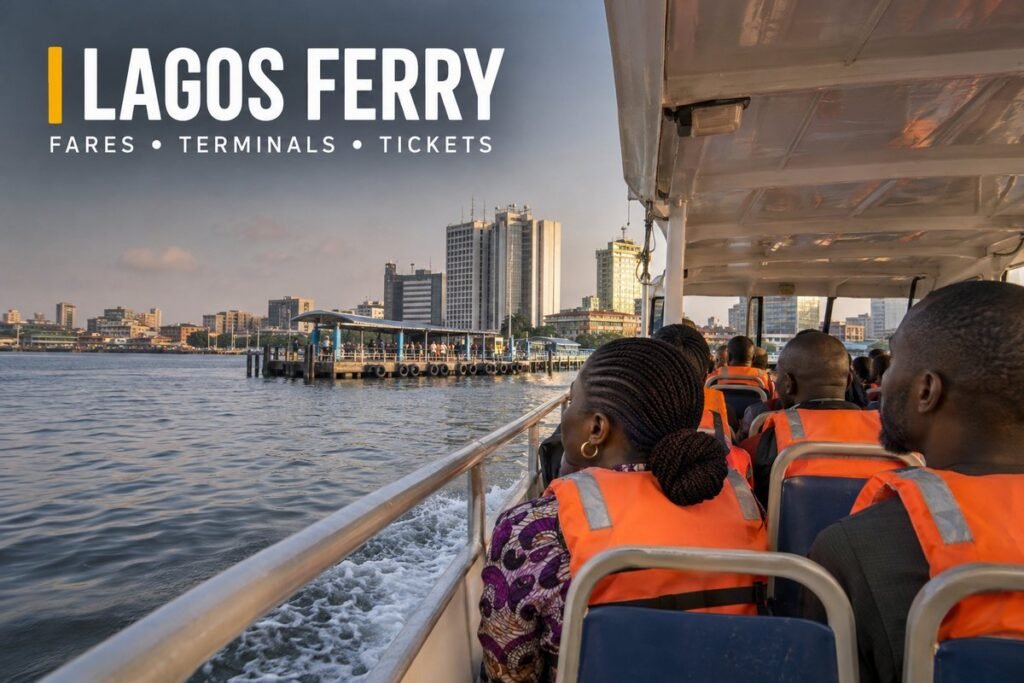
Whenever someone describes Lagos traffic at its worst, the Lagos ferry comes up as the way out, yet few people can say what it costs, where it leaves from or who runs it. The boats exist, they carry real numbers of passengers and they save time on a handful of corridors, but they remain a small part of the city’s daily movement.
What follows sets out how the system is organised, what the state and private boats charge, where the main jetties are, when the boats run and what to do once you reach the water. Fares on individual routes are covered in a separate guide, so this one concentrates on how the whole arrangement fits together.
How the Lagos Ferry System Works
Two kinds of operator run boats across the lagoon. The state runs a scheduled commuter service, and private companies run their own boats, usually on the busiest corridors and at higher fares. A business-press report from about a year ago found that ferries made up under 1 percent of daily public transport trips in Lagos, even though waterways cover roughly 22 percent of the state’s land and link 15 of its 20 local government areas.
The gap between that potential and the reality explains the Omi Eko programme, a €410 million project whose published targets include 15 new routes, 25 terminals, 140 km of dredged channel, more than 75 electric vessels and 25 million passengers a year. Those are targets, not results, and I found no report of how much has been delivered so far.
Who Runs the Lagos Ferry Service
The state service is called LAGFERRY, the brand of the Lagos State Ferry Services Corporation. It began carrying passengers in February, more than six years ago, and by January this year it had carried 4.4 million. Trips rose about tenfold in last December’s festive rush, which shows how quickly demand responds when the roads are packed.
More than five years ago the state launched a mobile app for the service at Badore jetty, alongside eight new ferries that joined a fleet of six. A Lagos ferry boat on the state routes carries 40 to 60 passengers, and the launch spoke of online and offline booking. I could not confirm what the app does today, in particular whether it takes payment, so ask at the terminal before you rely on it.
Private operators fill the gaps. They set their own timetables and prices, run smaller boats of about 30 to 40 seats and are seen mainly on the Ikorodu corridor and on the island beach runs. In January this year the state said that electric boats would arrive within the year and bring LAGFERRY fares down, but it gave no figure, so today’s fare table is still the one to use.
Lagos Ferry Price and What Sets It
The state boats charge between ₦1,500 and ₦2,500 on the routes in our guide to Lagos ferry routes, with Ikorodu to Five Cowries at ₦2,200 and the shorter Ebute Ojo and Mile 2 runs to CMS at ₦1,500. Private operators on the Ikorodu corridor charge more, as the table shows.
| Type of boat | Reported fare | How old the figure is |
|---|---|---|
| State service, most routes | ₦1,500 to ₦2,500 | Route list from October |
| Private boat, Ikorodu to Victoria Island, Lekki or Ikoyi (under 40 minutes) | ₦3,000 to ₦3,500 | Business report, about a year ago |
| Modern private ferry with 30 seats | about ₦3,000 | Same report |
| Private vessel with 40 seats | about ₦3,500 | Same report |
| Figures in a guide from last year | ₦200 to ₦1,500 | Out of date; not used |
On a similar run to Ikoyi, the private fare is ₦800 to ₦1,300 above the state fare each way. For a commuter making ten crossings a week, and assuming those fares hold, that is ₦22,000 on the state boat and ₦30,000 to ₦35,000 on a private one, a gap of ₦8,000 to ₦13,000. The same business report noted that the state fare sits near ₦1,500 but that its sailings are limited, so a cheaper ticket is worth less if the boat you need runs only twice a day.
State or Private
The state boats are the cheaper choice on the corridors they serve, and their sailing times are fixed, so they suit a commuter who can live by a timetable. A private boat costs more but may leave at a time or from a landing point that the state service does not offer. Ask both about the departure that you need, and compare the total, including what it costs to reach the jetty.
Lagos Ferry Terminals and the Map in Words
Every Lagos ferry terminal is a jetty on the lagoon, and the names matter because one area can have several. The ones that appear on the state timetables are Ikorodu in the north, Five Cowries at Falomo in Ikoyi, Addax Jetty on Victoria Island, CMS (also called Marina) and Ebute Ero on Lagos Island, Badore on the Ajah side, and Mile 2, Liverpool in Apapa, Ebute Ojo and Ijegun Egba on the western side, with Langbasa and Ijede on the Badore creek route.
It helps to think of three corridors. The northern one runs from Ikorodu to Ikoyi, the eastern one runs from Badore past Victoria Island, and the western one links Mile 2 and Ebute Ojo to CMS.
A proper Lagos ferry map exists as well. An independent data group published a public one nearly two years ago, showing public and private routes across nine local government areas, with estimated fares, boat types, departure times and directions to each jetty. I could not confirm that it is still updated, so check the times at the terminal. Whatever map you use, look up the jetty name in a map app before you set out, because reaching a jetty by road is part of the journey.
The Lagos Ferry Schedule
Timetables are built around commuters. The state boats leave the outer terminals from 6:30am and run again from about 3:30pm, while the return sailings leave the city side from about 7:30am and again from 4:30pm or 5pm. One guide from last year described weekday service between 6:30am and 6pm, with peaks from 6:30am to 9am and from 4pm to 6:30pm.
A Lagos ferry schedule printed in a guide is a starting point and not a promise. Weekend and public-holiday sailings may differ, and weather and tides can delay or cancel a boat, so confirm the day’s departure at the terminal. Arrive 10 to 15 minutes before the boat leaves, and keep a road backup in mind, because heavy rain or thunderstorms can stop the service.
Tickets, Payment and Safety
Ask at the terminal which payments are accepted for your sailing. Cash, POS and digital payment have all been mentioned, but they vary by terminal, so carry cash in case a machine is down. Get a ticket or receipt before you board and keep it until you land.
Life jackets are mandatory and should stay on for the whole trip. Follow the crew’s instructions, and do not board a boat that looks overcrowded. Keep phones and documents in a waterproof bag, and save a screenshot of your route details, since the signal at a jetty can be weak.
Planning a First Trip
- Pick the corridor and the two jetties, and look both up in a map app.
- Confirm the day’s departure time, the fare and the payment method with the terminal.
- Carry enough cash for the fare and for transport at the other end.
- Arrive early, put the life jacket on when told and keep it on.
- Work out the last stretch on land before you board, since a landing jetty is not always close to your destination.
For a leisure trip to the west, our guide to Lagos to Badagry by boat covers the water route. If the water is closed to you on the day, the main road link between the mainland and the island is the bridge in our guide to the Third Mainland Bridge.
Frequently Asked Questions About the Lagos Ferry
How much is the ferry in Lagos?
State boats charge about ₦1,500 to ₦2,500 on the listed routes, and private operators charge about ₦3,000 to ₦3,500 from Ikorodu to the island.
Where do the boats leave from?
From outer jetties such as Ikorodu, Badore, Mile 2 and Ebute Ojo towards Falomo, Addax Jetty, CMS and Ebute Ero, and back again later in the day. Which jetty serves you depends on the corridor, so start from the terminal list above and confirm the pairing before you travel.
When does the first boat leave?
State boats leave the outer terminals from about 6:30am on weekdays. Confirm the day’s departure first.
Can visitors use the Lagos ferry?
The boats carry ordinary fare-paying passengers, so a visitor follows the same rules as a commuter: pay at the terminal, wear the life jacket and keep your ticket.
Before You Go
Check the day’s departure, the fare and the payment method at the terminal, wear the life jacket throughout and keep a road backup. If you are weighing the boat against the bridge, price both for your exact corridor, because the saving depends on where you start and where you need to be.



Leave a Reply