
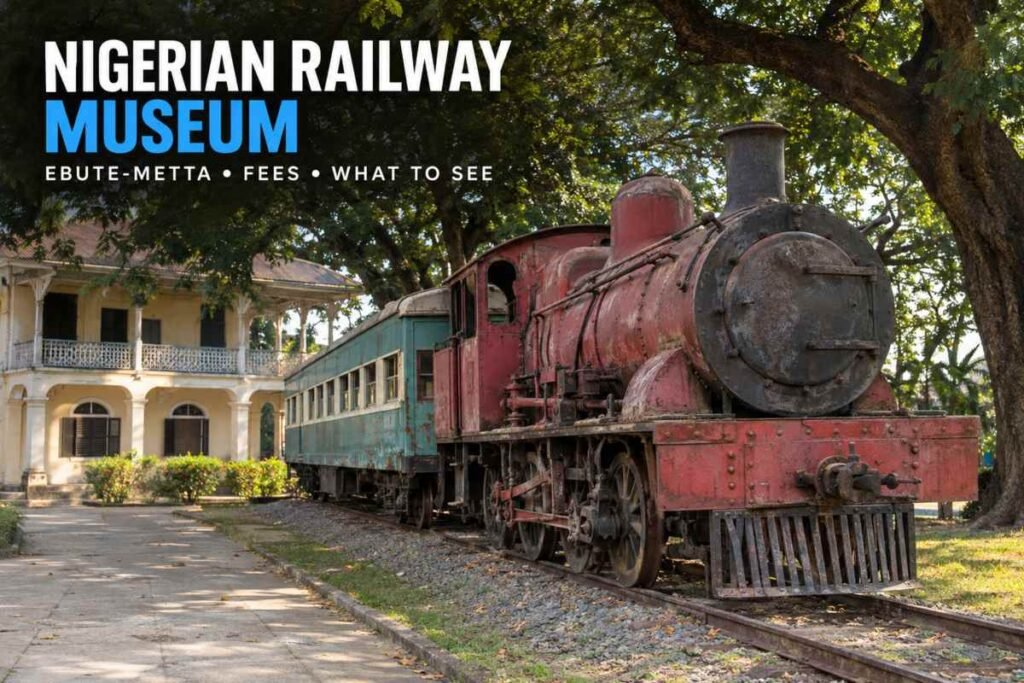
Behind a gate in Ebute-Metta, on the Lagos mainland, a colonial mansion and a yard of ageing locomotives hold a good part of the story of Nigeria’s railways. The Nigerian Railway Museum is small, run by volunteers and easy to overlook, which is why many Lagos residents have never been inside.
Below you will find what the museum is, what it holds, where to find it, what the entry fee might be, what photographers should know and why a British team recently came to look at it. The facts on the address, the hours and the price conflict between sources, so I set the figures side by side and say which are firm.
Nigerian Railway Museum at a Glance
The museum occupies Jaekel House, a two-storey colonial building put up in 1898 and named after Francis Jaekel, a former railway superintendent. It began as the home of the railway’s general manager and later served as a rest house for senior staff. Today it is a mini museum with a photo archive, a collection of tools and uniforms and a yard where old rolling stock stands.
| Point | What the sources say |
|---|---|
| Place | Railway compound, Ebute-Metta, Lagos |
| Building | Jaekel House, built in 1898 |
| Run by | Legacy, a volunteer heritage group |
| Entry fee | ₦2,000 in a recent review |
| Photography | Allowed, per the same review |
| Hours | Not confirmed for the museum |
Nothing here is an official notice. The compound sits inside the railway’s land, so access rules can change, and a phone call before you go is the safest plan.
The Legacy Nigerian Railway Museum Lagos Visitors Find
The legacy nigerian railway museum lagos is cared for by Legacy, a heritage group founded in 1995. The house was restored about sixteen years ago under the leadership of Professor John Godwin, working with the railway corporation. It now serves several purposes at once. It is a museum, a venue for weddings and picnics and a location for film, and a feature film and a music video have been shot there.
A Short History of the House
The mansion was built when the railway was new, and its first job was to house the manager of a growing network. Later it became a rest house, so the building has seen both the early colonial years and the railway’s busy middle decades. Its restoration saved a structure that would otherwise have been lost to damp and neglect.
Why the Railway Matters to Lagos
The railway out of Lagos carried cocoa, palm produce and groundnuts to the coast and brought manufactured goods inland, and the offices, workshops and staff houses of Ebute-Metta grew around that traffic. A visit makes the link clear. Passengers today ride modern trains on new lines, while the compound shows the older network that came first and shaped how the city grew along the mainland.
Who Runs It
Legacy maintains the museum, and the group’s president has been quoted on the work. The museum is not part of the national museum system, so do not expect its staffing, signs or hours to match those of the National Museum in Lagos.
What You Can See
The photo archive covers the 1940s to the 1970s, with pictures of people, places and events from the years before and after independence. Tools, equipment and uniforms sit alongside them, and the whole display tells the working story of the railway in a few rooms.
The Yard and the Rolling Stock
Outside, an old running shed shelters ageing locomotives and coaches. Visitors mention steam cranes, VIP coaches and a historic coach used by Queen Elizabeth II on her visit to Nigeria. One report also describes the last remaining stretch of the 2ft 6in track of the Lagos steam tramway, which ran from 1902 to 1933. The reports do not agree on every item, so ask what is currently on view.
Allow Two Hours
The house and the yard are compact. Allow about two hours if you read the captions and look closely at the engines, and longer if you book a picnic. That is my own estimate, since no source gives a recommended length of visit.
Getting There, Hours and Fees
The address is the first conflict. The railway corporation’s page gives it as 1 Okeira Road, Railway Compound, Ebute-Metta, while a heritage listing and the group’s own material say 17 Federal Road, in the same railway compound. A review gives it as quarter 17, Federal Road. All three point to one district, so give a ride-hailing driver the museum’s name and the word Ebute-Metta and share your live location. The group takes bookings by phone, so use the number on its own website.
What to Bring and Wear
Wear closed shoes, since the yard has uneven ground, old rails and rusted metal. Bring water, a hat, a charged phone and small notes for the entry fee and the guide. Do not climb on the engines or coaches, and keep children close, because the structures are old and some parts are not safe to stand on.
The Entry Fee
A review from June gives ₦2,000 for museum entry, ₦3,000 for a picnic and ₦4,000 for a picnic with a guided tour. An older listing says ₦200 for an adult and ₦100 for a child, which is almost certainly out of date after years of price rises. I treat the June figures as the better guide, but I found no price list from the museum itself, so confirm the amount when you book.
Opening Hours
The group’s website lists Monday from 10:00 to 16:00 and Tuesday to Saturday from 10:00 to 17:00, but it does not say these are the museum’s visiting hours, and no other source gives any. Phone ahead and ask whether a guide will be on site. Do not assume the museum opens on Sundays or public holidays. Because the compound also hosts weddings and picnics, ask whether it is booked for an event on your day, since a private function can limit what visitors are allowed to see.
A first-time visitor should ask four things on the phone: whether the museum rooms are open, whether the yard is open, whether a guide is included and whether a picnic space can be reserved. A clear answer to each saves a wasted journey across the mainland, and it also shows the group that you are serious about the visit.
The Legacy Nigerian Railway Museum Photos and Reviews
Photography is allowed, according to the June review, and the yard is the part to photograph. Rust-coloured engines in front of the old house make a good image in the morning light. Ask a guide before you photograph people, and check whether a tripod or a drone is acceptable, since the compound is private property.
Anyone who looks for the legacy nigerian railway museum photos online will find mostly pictures of events held there, so use them to judge the setting, not the collection. The same goes for the legacy nigerian railway museum lagos photos on social media, which tend to show weddings and picnics.
Reviews are few. The legacy nigerian railway museum lagos reviews I could find are limited to one recent account and some listings, and none gives a complete picture. The review that gave the fees describes a well-kept compound and a guided tour option, but a single review cannot establish a standard of service. Read the most recent posts and ask someone who has been lately.
UK Nigeria Railway Museum Collaboration
In April a team from the British Museum and Oxford University visited the compound to explore heritage cooperation. A uk nigeria railway museum collaboration of this kind could cover restoration, conservation and the exchange of knowledge, and the visit was described as a familiarisation trip. No project, timeline or funding was announced, so I treat it as an interest, not a plan.
If you visit soon, you are seeing the collection before any such work begins. That is a reason to go, because conditions may change, and a reason to ask the guide what is at risk and what is being repaired.
Pairing the Visit With Other Stops
Our guide to the museums in Nigeria lists other places that suit a heritage day, and the page on the Nigerian Railway Corporation train schedule is useful if the visit makes you want to ride a train afterwards.
Frequently Asked Questions About the Nigerian Railway Museum
Where Is the Nigerian Railway Museum?
In the railway compound at Ebute-Metta, Lagos, inside Jaekel House. The street address is given in two ways, so use the name of the museum when you ask for directions.
How Much Does It Cost to Enter?
A June review gave ₦2,000 for museum entry. An older listing gave ₦200 for adults, so confirm the price before you go.
Can You Take Photographs?
Yes, according to the review, but ask before photographing people and check the rules on tripods and drones.
Is There Any Link With the British Museum?
A team from the British Museum and Oxford University visited in April to explore cooperation, but no project has been announced.
Before You Go
Call the group to confirm that someone will be there, agree the fee and ask about parking. Travel in daylight, bring water and a camera and keep your visit to the house and the yard. A short trip to the Nigerian Railway Museum shows how much of the country’s railway story survives in a single compound.




Leave a Reply