
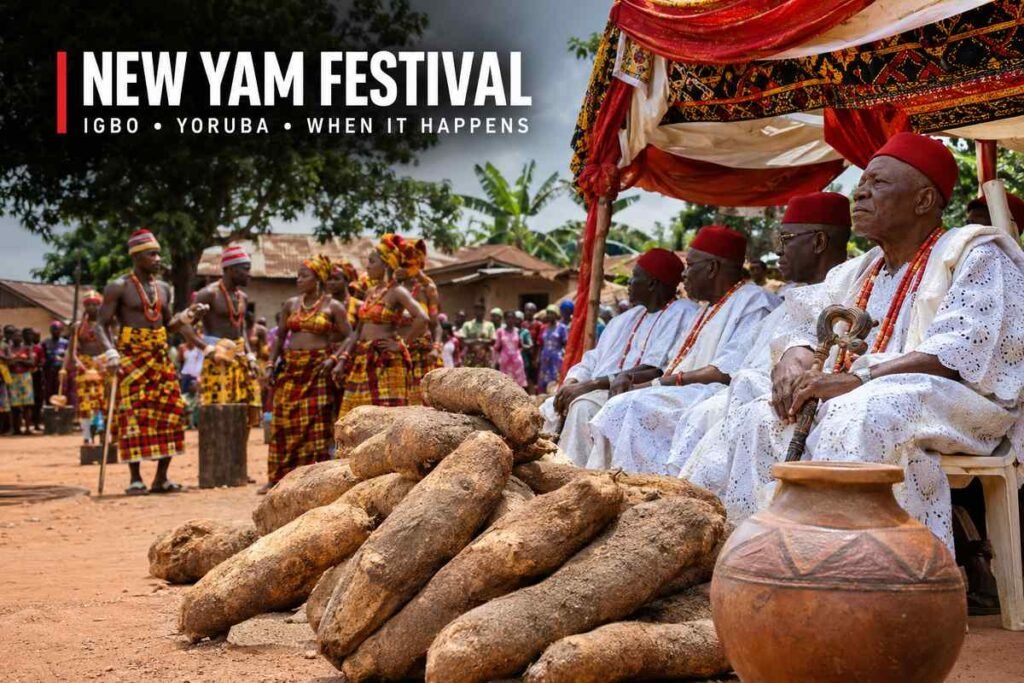
Every harvest season, towns across southern and middle Nigeria stop work, bring out their finest cloth and give thanks over a single crop. The New Yam Festival is the best known of these celebrations, and it is far older than any tourism brochure that now advertises it.
Below you will find what the rite means, how it differs from one people to the next, why it has no fixed calendar date and how a visitor can attend without getting in the way. Some sources disagree on names and timing, so I say where the facts are loose and I do not invent figures that nobody has published.
New Yam Festival at a Glance
The festival marks the end of the rainy season and the first harvest of the yam, the staple that many farming communities treat as the king of crops. It thanks the deities and the ancestors for the harvest, and nobody is meant to eat new tubers until a chosen elder has performed the rite. Among the Igbo it goes by Iri ji, Iwa ji or Ike ji, depending on the community, and the name changes again among other peoples.
| Point | What the sources say |
|---|---|
| What it marks | First yam harvest, end of the rains |
| Usual timing | August and September, sometimes October |
| Main rite | An elder offers yam, then eats first |
| Length | One day to a week or more |
| Fee to watch | None, no tickets |
| One national date | None |
A search for new yam festival nigeria returns Igbo celebrations first, but the tradition runs across the south and the middle belt. There is no central organiser and no national calendar, so treat every plan as local. Each town fixes its own day, and in many Igbo communities the new moon of August signals the start of preparations.
Why the Yam Matters
Yam is more than food in these regions. It takes a full season to grow, it stores well and it has long stood for a farmer’s standing in the community, which is why the first tuber is treated with ceremony and the harvest is not simply eaten at will. Many households still judge a good year by the size of their yam barn. The festival turns that private pride into a public thanksgiving, shared with neighbours, relatives and the dead.
New Yam Festival in Igbo Land
The new yam festival in Igbo land is the version most Nigerians picture. Its heart is a rite in which the eldest man, the king or a titleholder offers the first yam to the earth deity and the ancestors, and then eats the first piece himself on behalf of the community. The yam is usually roasted and taken with palm oil. Until that moment nobody else touches the new crop.
The Eve of the Festival
In several communities the last of the old yams must be eaten or thrown away before the new ones are cut, so the year begins with a clean store. Households sweep compounds and plan the soups, and the day itself is given over to feasting that centres on yam in every form.
Igbo Towns and Their Own Customs
No two towns hold the day in quite the same way. The new yam festival igbo families keep in Arochukwu, in Abia State, is described as especially lively, with Ekpo masquerades in the procession. Igbo-Ukwu holds a Maiden New Yam Festival, and Oba and Nnewi hold celebrations of their own. The Igbo diaspora also marks the day, and there are gatherings abroad, in Dublin among other cities.
Yoruba and Other Peoples
Igbo communities do not own the tradition. The new yam festival yoruba towns celebrate is often called Eje, and in Ekiti it is known as Odun Ijesu. One account of the Ekiti rite describes a day of fasting before the feast, followed by a yam split into two or three pieces and tossed into the air. If the pieces land in different ways the omen is good, and if they all fall alike it is bad.
Other peoples have their own names and customs:
- Okpe, in Delta State: Wasigbeenile, a thanksgiving in which visitors bring bush meat, goats and yams to the palace of the Olopke.
- Igede, in Benue State: Igede-Agba, held in September and doubling as the national day of the Igede people.
- Yakurr, in Cross River State: Leboku.
- Idoma: Orureshi.
- Ogidi and Lokoja, in Kogi State: homage to the king, dances and gunshots in Ogidi, and a harvest celebration in Lokoja that sits beside the Donkwo fishing festival.
If you typed “new yam festival is celebrated in which state” into a search box, the honest answer is that it is celebrated in many. Abia, Anambra, Enugu, Imo, Delta, Kogi, Benue, Cross River and Ekiti all have communities that mark it, and the programme changes with each.
New Yam Festival Date and Best Time to Go
Anyone looking for the new yam festival date will find that no single day exists. The sources give windows that range from August to September, and one gives August to October, which fits a harvest that depends on when the rains end. The Igede date in September is the firmest figure I found, and even that is a month, not a day.
I found no published timetable for any community. To plan a trip, ask the town union, the traditional ruler’s palace or the local government cultural office, and expect the answer to arrive only a few weeks before the event. Book flexible transport, and keep two or three days free around the expected date.
Mid August to mid September is the sensible window for a first visit. The roads are still wet in places, so allow extra time for every leg. Leave the date open until the town confirms it.
What Happens on the Day
Expect a mix of ritual and party. The formal rite comes first, with prayers, the offering and the elder’s first bite. After that the programme opens up with dances for men, women and children, parades, masquerades and displays of fine cloth. Celebrations can last a day or run for a week or more, depending on the town.
Cloth, Music and Dress
Dress is part of the day. Men wear wrappers and caps, women wear wrappers and head ties in matching colours, and titleholders wear the regalia of their rank. Music comes from drums and gongs, with songs that thank the earth and the ancestors, and masquerades move through the crowd. Spectators are expected to give dancers room and to step back when a masquerade passes.
Food and Drink
The feast is built on yam. Pounded yam with egusi or ogbono soup is the picture most people have, and roasted yam with palm oil is the ritual dish. Visitors who are invited into a compound are expected to eat, and to refuse politely only when they cannot manage more.
The Festival in Things Fall Apart
Readers who search new yam festival things fall apart are usually after the feast in Chinua Achebe’s novel, where the village of Umuofia honours the earth goddess and the ancestors with a day of eating, drinking and wrestling. The book is fiction, but it gave many readers their first picture of the rite, and it helps explain why the festival still carries so much weight.
Visiting as an Outsider
You do not need a ticket, but you do need an introduction. Arrive through a host if you can, a friend from the town or a member of the town union, because a stranger who turns up unannounced may be shown a place at the back. Dress neatly, greet the elders first and ask before you photograph ritual moments or masquerades.
Carry small notes for gifts, drinks and transport, and keep your phone out of sight in a crowd. Ask your host what gift is expected, since a bottle of drink or a small cash present is common. Towns fill up, so book a room early.
Most celebrations are held in towns and villages, not big cities, and you will travel by road. Awka is roughly 27 km from Nnewi and 32 km from Onitsha, which puts several Igbo towns within an hour or so of one base on a good day, and the rains can double that. For the Igbo heartland, our guide to hotels in Awka is a base for visits to the surrounding towns, and the places to visit in Anambra State page lists what else is near. If you prefer a festival with a published date and an organiser, the Argungu fishing festival is the easier choice.
Check the safety position before you commit. At least one government advises against all but essential travel to Abia, Anambra, Imo, Benue and Kogi, so read current advice, travel by day and tell your host your route. The risk is not the festival itself, which is a communal gathering, but the roads around it.
Frequently Asked Questions About the New Yam Festival
Which State Celebrates the Festival?
Many do. Communities in Abia, Anambra, Enugu, Imo, Delta, Kogi, Benue, Cross River and Ekiti each mark it in their own way.
When Is the Festival Held?
Usually from August to September, and sometimes into October. Each town chooses its own day, so there is no national date.
What Do the Igbo Call the Festival?
Iri ji, Iwa ji or Ike ji, depending on the community.
Do You Need a Ticket to Attend?
No. Entry is free, but go with a host and bring small notes for gifts and transport.
Before You Go
Pick a town, contact its union or palace and wait for the date before you buy a ticket. Pack neat clothes, small cash and patience, and treat the first rite with the quiet it deserves. A well-timed visit is one of the clearest ways to see how a harvest still shapes community life in Nigeria.




Leave a Reply